The changing orbit
The Moon’s threatened collision turns the familiar night sky into a source of existential danger.
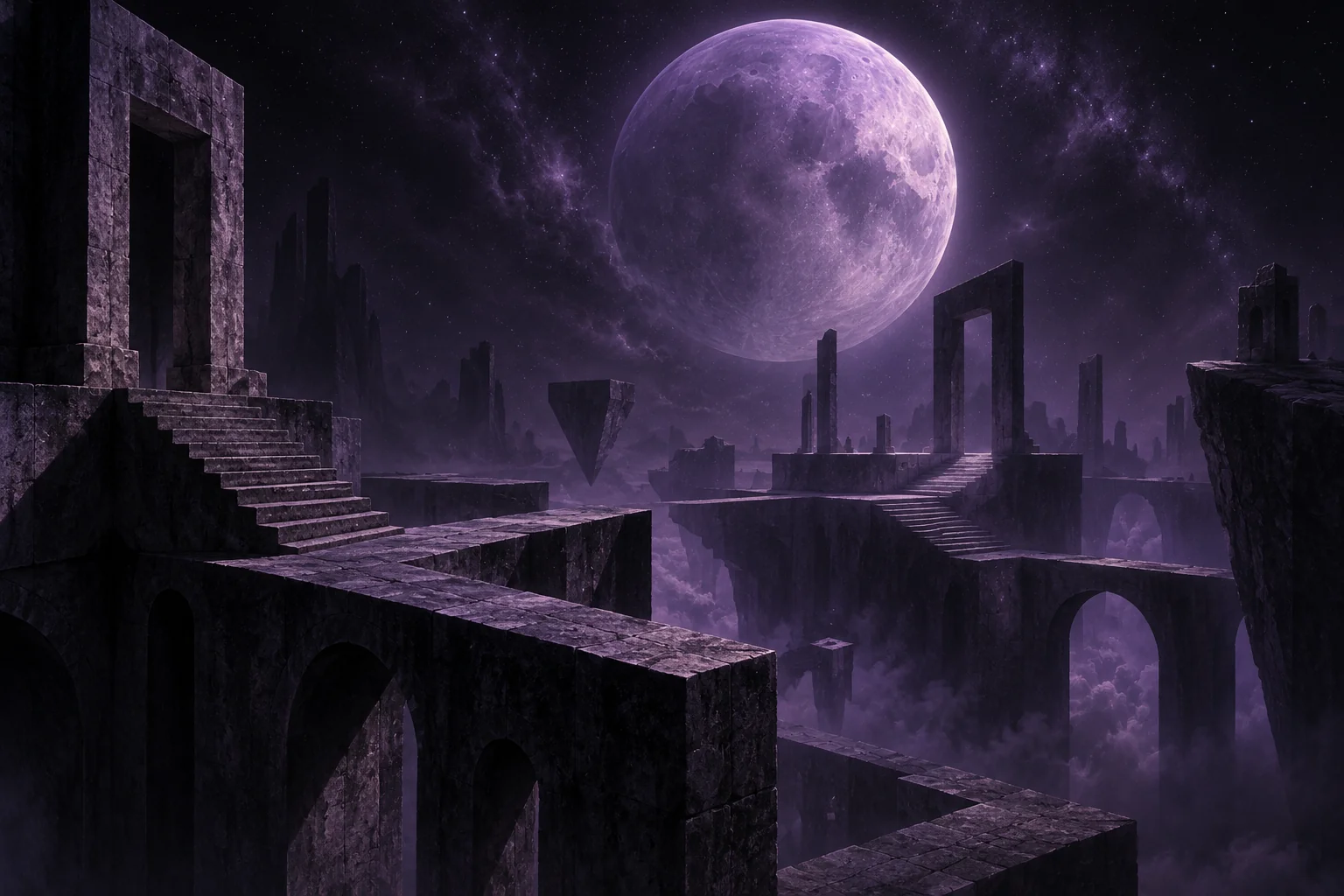
A powerful cosmic myth. A very different scientific Moon.
Directed by Roland Emmerich
Scene descriptions are paraphrased. Symbolic readings are editorial.
The Moon’s threatened collision turns the familiar night sky into a source of existential danger.
The film reveals a constructed lunar world and a hidden history. This is its science-fiction premise, not an accepted model of lunar structure.
An artificial intelligence threatens the civilization that produced it, extending the creator–creation conflict to a cosmic scale.
NASA’s account uses geological and geophysical evidence for crust, mantle and core.
DART changed an asteroid moonlet’s orbit in 2022. This does not establish an ability to redirect Earth’s Moon.
Megastructures can be thought experiments; this specific lunar-engineering claim conflicts with the evidence presented by NASA.
Scientists continue to investigate the details of lunar formation. That uncertainty does not make a hollow technological shell an equally supported explanation. A competing model must explain the measurements at least as well as the existing account, not merely point to open questions.
Tracking objects, visiting the lunar surface and slightly changing a small asteroid’s motion differ radically from constructing or controlling a moon. Lunar exploration is real. The movie’s artificial habitat and intelligence swarm remain fictional mechanisms.
The concealed interior offers a symbol of hidden history beneath familiar appearances. Cycles of illumination and darkness invite readings about change, the unconscious and repeated beginnings; these are cultural and personal associations.
The ancient-engineer story imagines human beings as heirs to a forgotten technological lineage. Spiritually, that can become a question about responsibility for inherited power. It is not evidence that such engineers created the Moon.
EXPANDED INDEX2012Finding your creator does not guarantee finding your purpose.
 EXPANDED INDEX2009
A resemblance after the event is not a prediction before it.
EXPANDED INDEX2008The deeper journey is not always a geographical one.